2026 Dangermond Research Fellow Visits Turenscape: Exploring Chinese Cultural Landscapes, Ecological Urbanism, and Water-Sensitive Design
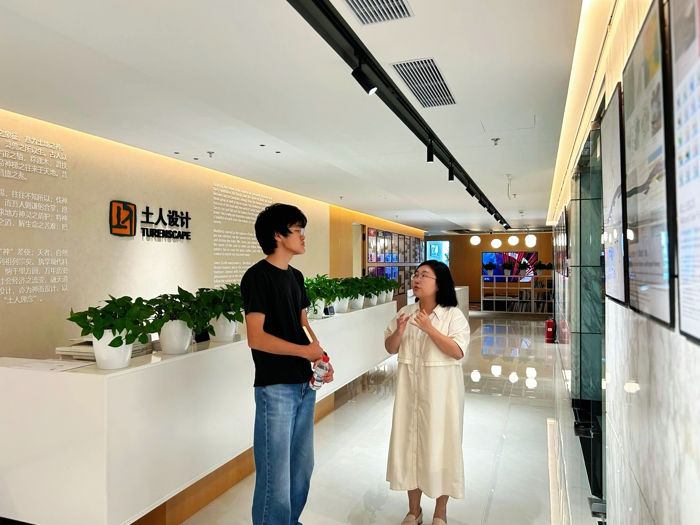
Recently, Jayden Jiang, a 2026 Dangermond Research Fellow and a landscape architecture student at California State Polytechnic University, Pomona, visited Turenscape for an exchange on Chinese cultural landscapes, ecological urbanism, and water-sensitive design. The visit forms an important part of his research trip in China from July 31 to August 13, 2026.
Jiang’s research explores the relationship between historic cultural landscapes and contemporary ecological urbanism, with particular attention to the dual role of water in landscape architecture. On the one hand, water serves as a fundamental medium of cultural landscapes—organizing spatial experience, shaping movement and views, and embodying cultural understandings of the relationship between humans and nature. On the other hand, water is a vital natural process through which ecological infrastructure can be constructed, providing multiple ecosystem services including stormwater retention, water purification, habitat restoration, and enhanced urban resilience.
By comparing traditional Chinese gardens with contemporary ecological practices, Jiang seeks to better understand how landscape architecture can sustain cultural identity and a sense of place while responding to the environmental challenges brought about by climate change and rapid urbanization.
As part of his research itinerary, Jiang will visit representative cultural landscapes, ecological projects, and urban public spaces in Shanghai, Hangzhou, Suzhou, Beijing, and Tianjin. These include Shanghai Houtan Park, West Lake and Xixi National Wetland Park in Hangzhou, the Master of the Nets Garden and the Humble Administrator’s Garden in Suzhou, Beijing Olympic Forest Park, and Tianjin Qiaoyuan Park.
Through field sketching, photography, documentation of spatial sequences and movement, observation of water systems, mapping, and interviews, he will conduct comparative studies across these sites. His research examines the continuities and transformations between traditional cultural landscapes and contemporary ecological design, particularly in their approaches to water, topography, spatial experience, and the human–nature relationship.
During his visit to Turenscape, Chen Xi, Chief Planning and Design Engineer of Turenscape’s Design Division V, introduced the firm’s nearly three decades of research and practice, ecological restoration, and urban stormwater management. The discussion highlighted Turenscape’s Land-Based, Water-Driven Holistic Solutions and its use of Nature-based Solutions (NbS) to address flooding, water pollution, and water scarcity at urban and regional scales—an approach embodied in Turenscape’s concepts and practices of the Sponge City and, more broadly, the Sponge Planet.
At the core of this approach is a fundamental shift away from conventional engineering dominated by gray infrastructure and the attempt to resist or control nature. Instead, water is understood as a powerful force that shapes land and sustains life. By protecting and restoring natural hydrological processes and by integrating wetlands, rivers, lakes, agricultural landscapes, and urban open spaces into an interconnected ecological infrastructure, landscapes can function like sponges—retaining, slowing, cleansing, and adapting to water.
Such an approach offers a more economical, ecological, and resilient alternative for addressing floods, droughts, water pollution, biodiversity loss, and other challenges intensified by climate change.
The discussion also explored the spatial organization and borrowed scenery (jiejing) of traditional Chinese gardens, water-system design in contemporary parks, Sponge City strategies and Nature-based Solutions, public experience in ecological restoration projects, and the relationship between landscape architecture education and professional practice.
Chen noted that China’s traditional wisdom of water management, city building, and garden making is not simply a matter of landscape aesthetics. It represents a form of survival wisdom developed through centuries of adaptation to natural processes. Embedded within this tradition is a holistic understanding of mountains and water, topography and hydrology, and the relationship between humans and nature. From vernacular strategies for adapting to floods and droughts to the orchestration of water, terrain, views, and spatial sequences in classical gardens, this tradition reflects an enduring principle: design with local conditions and work with, rather than against, natural processes.
In the face of flooding, water pollution, water scarcity, ecological degradation, and other challenges brought about by climate change and rapid urbanization, contemporary landscape architecture must rediscover this wisdom and integrate it with modern ecological science and design. Rather than seeking to conquer and control nature, design can restore and harness natural processes, build critical ecological infrastructure, and let nature do the work. In doing so, it can achieve multiple ecosystem services with less engineering intervention, enhance the resilience of cities and territories, and ultimately foster a more harmonious relationship between people and nature.
Jiang noted that his research in China aims to deepen his understanding of the human–nature relationship embedded in Chinese cultural landscapes and to connect these lessons with contemporary challenges in California, including drought, aging infrastructure, and urban water management. Through this comparative perspective, he hopes to explore landscape design approaches that are ecologically resilient, culturally meaningful, and sustainable.
The visit offered an opportunity for an emerging international researcher to gain a deeper understanding of China’s ecological landscape practices and to examine the continuities and transformations between traditional cultural landscapes and contemporary ecological urbanism. It also created a new connection between Turenscape and overseas universities, research institutions, and the next generation of landscape professionals.
Turenscape will continue to promote academic dialogue, project visits, and professional exchange, advancing the translation and application of ecological design principles across different geographic and cultural contexts and using Nature-based Solutions to address the shared climate and environmental challenges of our time.