Turenscape is a pioneering design firm engaged in a wide range of professional services including urban and regional planning (national territorial planning, urban master planning, urban design, tourism strategy and planning), architectural design, landscape architecture, and integrated design-build services. Its project scope spans urban parks and green spaces, residential communities, commercial precincts, scenic destinations, and historic and ecological conservation areas—covering planning, design, and construction management.
Turenscape views landscape and urban design as an “Art of Survival,” advocating for a new aesthetic known as the “Big Feet Revolution.” Its mission is to reflect the harmony of “Nature, Man, and Spirits” and to pursue the preservation and inheritance of cultural heritage, while advancing sustainable development between humanity and nature.
Landscape Architecture
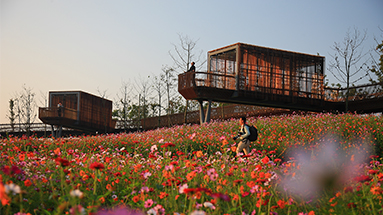
Inspired by the principle of “Art of Survival,” Turenscape responds to the urgent needs of the era by embracing the responsibility of re-establishing the harmonious relationship between heaven, earth, and humanity—addressing environmental challenges such as flood control, water resource management, biodiversity conservation, cultural heritage preservation, and land restoration. Turenscape removes the hardened surface of concrete from the skin of nature, replacing it with ecological corridors; restores wetlands, allowing native species to flourish; and rebuilds cultural identity and emotional connection to place. Through continuous innovation, Turenscape’s landscape projects have garnered numerous national and international awards and are widely recognized within the profession.
Planning
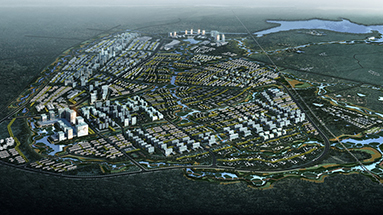
Challenging conventional planning models based on population forecasting and infrastructure-driven urban forms—with rigid zoning between ecological and urban development zones—Turenscape introduces an alternative methodology rooted in “Negative Planning” and Ecological Security Patterns (ESP). To address key ecological challenges amid rapid urbanization, Turenscape develops integrated planning strategies guided by ESP, aiming to preserve ecological processes at maximum continuity and integrity, and create high-quality urban environments with diverse ecosystem services. The term “Ecological Security Pattern” was formally written into China’s national policy during the 18th CPC National Congress. Under this theoretical framework, Turenscape has delivered numerous projects across territorial, regional, urban, rural, and tourism planning domains—earning high-level recognition and contributing significantly to ecological civilization and Beautiful China initiatives.
Architecture

Turenscape’s architectural philosophy continues its core principle of harmony among Nature, Man, and Spirits—integrating ecological protection, cultural continuity, green building practices, and contemporary aesthetics. Designs emphasize low-cost, eco-friendly, and site-sensitive architectural forms, aiming to unify function with natural settings. Turenscape honors the “spirit of place” by carefully selecting building sites, responding to local climates, and leveraging its interdisciplinary expertise in planning, landscape, architecture, and interiors to deliver integrated design solutions. Many of Turenscape’s architectural works have won international architectural awards.
Sponge City
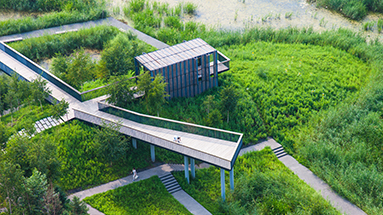
As early as 2003, Professors Kongjian Yu and Dihua Li proposed the concept of the "Sponge" to address China's mounting water crises: scarcity, pollution, flooding, and habitat loss. They envisioned “sponge” as the natural system’s capacity to regulate stormwater, advocating for cross-scale water-based ecological infrastructure to provide holistic solutions for both urban and rural water challenges. Under this vision, Turenscape led a series of pioneering projects—from Qiao Garden in Tianjin to Houtan Park in Shanghai, from the Sanlihe Greenway in Qian’an to the Qunli Stormwater Park in Harbin—placing the firm at the forefront of the Sponge City movement. Turenscape continues to refine its approaches and technologies, advancing replicable, multi-scale, regionally adaptable stormwater management systems with low-maintenance operational models, setting benchmarks for sustainable water urbanism globally.